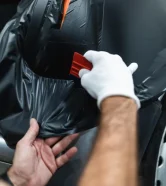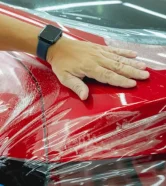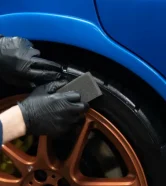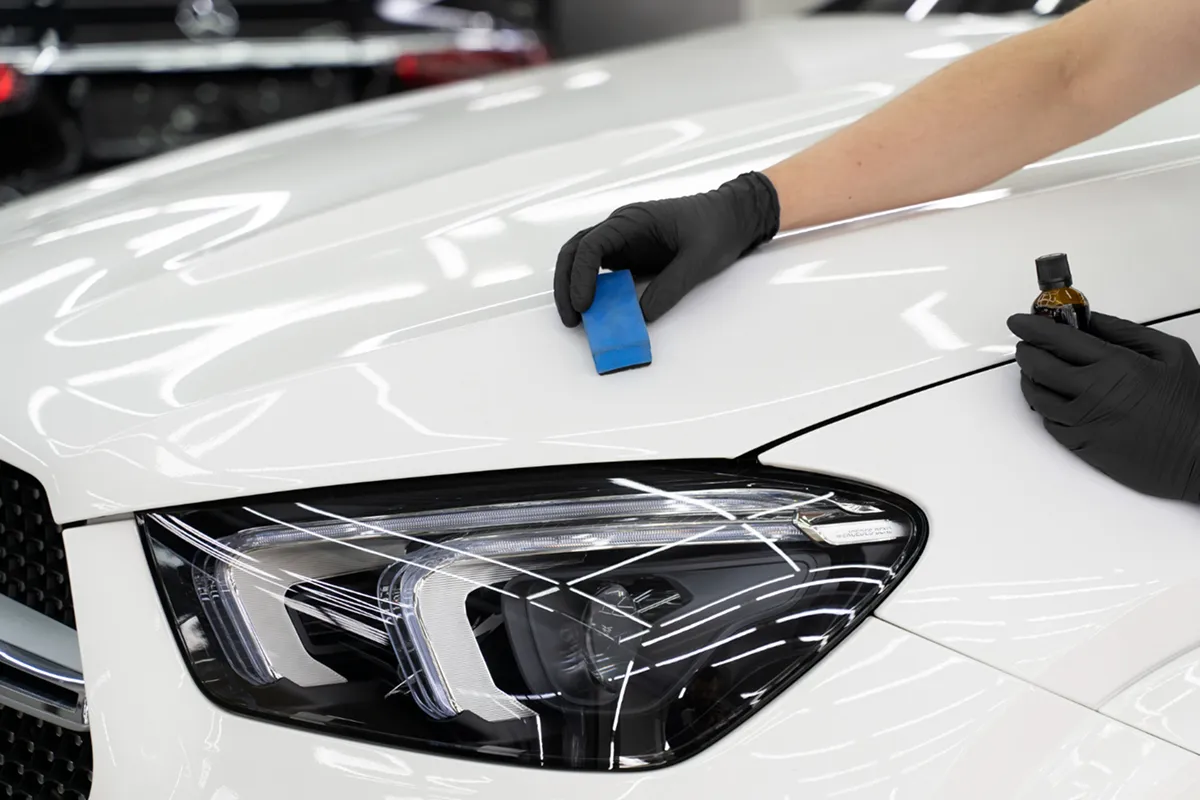
What Is Standard Car Paint Protection (Wax and Sealants)?
We usually apply a protective coating to safeguard the paint of our vehicles. These coatings are applied over the clear coat of the car, forming a thin protective layer. This layer helps protect the vehicle from dust, minor environmental pollutants, UV rays, and light oxidation. It includes carnauba waxes, polymer sealants, synthetic waxes, and a simple layer of paint sealants.
When applying a wax, you apply a layer of wax on the top of the paint, which provides a shine and medium protection. Since the layer has not been chemically attached to the paint, it will slowly wear off as it is exposed to weather conditions, washing, UV light, etc. As a result, application of wax or sealant often should be repeated in order to remain effective. According to one of the explanations of the specifics, traditional wax offers some basic protection against UV rays and minor wear, yet it needs to be reapplied regularly to be effective.
What is ceramic coating?
Semi-technological protection of the exterior is a ceramic coating as a relatively new feature. It implies liquid polymers (usually silicon dioxide or other nano-ceramic particles) that, when used as directed, are chemically bonded to the clear finish of the paint to form a semi-permanent protective coating. Since the ceramic coating does not just lie on the surface of the vehicle but is actually a part of it, it is more durable, glossy, and hydrophobic (beads water and dirt roll off) and requires fewer maintenance procedures in general. Sources say the layer can last years as opposed to weeks or months. The chemistry is to fill the microscopic pores in the paint to create an even coating that is less likely to adhere to contamination.
Key comparison: Protection, durability, and maintenance
| Feature | Conventional Protection (Wax/Sealant) | Ceramic Coating |
|---|---|---|
| Bonding to paint | Topical layer, not chemically bonded | Chemical bond with clear coat |
| Longevity | A few weeks to a few months (3–6 months typical) | 1–5 years or more, depending on product & prep |
| Protection level | Moderate — good for light contamination, UV | High-strength barrier vs UV, contaminants, hydrophobic effects |
| Maintenance effort | Frequent re-application, more washing/detailing | Less frequent — easier cleaning, hydrophobic surface |
| Upfront cost | Low to moderate | Higher |
| Suitability for serious protection | Basic protection, good for budget use | Premium protection, long-term investment |
| Pitfalls | Wears off quickly, less resistant | Requires good surface prep & professional application; costlier |
In-depth analysis: Pros & cons of each
Advantages of Traditional Protection
- Less expensive: Simple to install a project, numerous quality DIY projects.
- Fast to apply: Wax vs multi-layer coating ceramics.
- Good visual improvement: It is easy to create gloss and a wet look.
- Flexibility: You are able to reuse frequently and adjust the appearance without difficulties.
Disadvantages of Traditional Protection
- Very short life: Has to be reapplied every couple of months.
- Very little protection against the heavier contamination or the weaker forms of the acid rain, the dropping of birds, etc., is weaker than ceramic.
- Heavy maintenance: Washed more often, more labor to maintain the look of the finish.
Advantages of Ceramic Coating
- Long service life: Lasts for years with experience.
- Better quality: Protection against UV, chemical etching, contamination, and cleanup.
- Increased looks: more gloss, fewer wrinkles, waterproofing.
- Long-term savings in maintenance: Dot hydrolysis, reduced wash troubles.
Disadvantages of Ceramic Coating
- Expensive at launch and usually needs a professional application.
- Not bulletproof: Fails to remove any type of damage (rock chips, deep scratches).
- Surface preparation: any blemish that gets pre-coated is fixed; poor results occur in case of poor preparation.
- Not entirely maintenance-free: Although much easier, you must still take good care of it.
Which one is best for your car and situation?
The best option will be based on the use of your car, money, preferred appearance, and the amount of time you like to spend on maintenance.
When Conventional Protection may be sufficient
- You might be selling a car that is old soon, or budget is one of your main considerations.
- In case you do a regular detailing and you are not too concerned about re-doing periodically.
- Provided that your car is not heavily used, is in good condition, and you drive in low-contamination conditions (garage, less dust, less exposure).
- In case you have a budget and not a long-term investment.
When Ceramic Coating is the better choice
- In case you have a premium or luxury car and want to retain the showroom gloss and resale value.
- When you are in extreme conditions (bright sun, seashore salt air, pollution, sand/dust), the additional coverage is more applicable.
- When you do not need the vehicle to be serviced as much, and you would like to have a longer and cleaner vehicle.
- In case you want to drive the vehicle over the long term and want the set-it-and-forget-it for a few years.
Summary & Recommendation
To conclude, the dilemma between traditional protection and ceramic coating is reduced to the trade-off between cost, maintenance work, and the target level of protection.
Ceramic coating is the smart option to consider in case you want the best protective performance for your vehicle and are ready to spend money on it. Conversely, when the budget is a factor or the vehicle is not driven in aggressive conditions, then conventional protection is also an option.
In the UAE, the service offered by Exclusive Car Care is highly supportive of the services of applying ceramic coating to the vehicle, based on the conditions in the area (dust, heat, sand)—you can check with them to have a consultation and choose an appropriate level of protection to apply to your vehicle and use.
If you want to do ceramic protection at home, these blogs can help you. How To Apply Ceramic Coating On Your Car At Home: A Complete Guide
FAQ
Yes. Ceramic coating has a lasting protective effect, which can last several years, unlike wax or sealants, which have the short durability of a few months. It is more resistant to UV rays, oxidation, and chemical stains and offers less maintenance to maintain gloss and shine.
No, ceramic coating will not leave your car without scratches. It merely gives a surface layer that is harder and thus resistant to minor swirl marks and less susceptible to scratches when in light contact. Scratches or deep rock chips might still occur.
The average wax life is approximately 1-3 months, whereas a good-quality ceramic coating may last up to 2-5 years or even longer, depending on the type of brand, surface preparation, and care.
Yes, when you are going to maintain your car over a few years. It is also more expensive at the outset but will save time and money in the long term, since it will not require frequent waxing, washing, and detailing.
DIY ceramic coating kits exist, but it is preferable to have them applied by professionals. Professionals make the surface well-prepared, cured correctly, and evenly coated, which influences the durability.
Yes. After the ceramic coating is done, there is no need for wax. The coating offers better gloss, weathering, and hydrophobic (water-repelling) features without the use of a covering of wax.
The quality and the care of most professional ceramic coatings last 2-5 years. Maintenance “top-up” sprays can be used every few months to increase the life cycle as well.
Absolutely. Watney waxes and sealants are affordable to those with limited cash, or to cars that have not had to survive the severe weather and prolonged exposure. They are simple to place, take off, and replace whenever.
Yes, only with the help of polishing or paint correction. It is a chemical bond to the clear coat and therefore cannot be removed by a simple washing or cleaning process.
Clean the vehicle regularly using pH-neutral car shampoos; no abrasive substances should be used. Do not use waxes or silicone-based products, which may influence the performance of the coating.